‘Self-Healing’ Nuclear Command and Control Systems and AI Agents
Fall continues to jam-packed, so please accept my apologies for the large gap between my last newsletter and today’s edition. DC is starting to get chillier, and I’m thankfully bound for sunny Hawaii for work (and a little fun afterwards pre-Thanksgiving). I thought I’d share some more thinking-in-progress in the genre of agentic AI and nuclear security in line with some of my previous posts here. (Comments welcome, as always!)
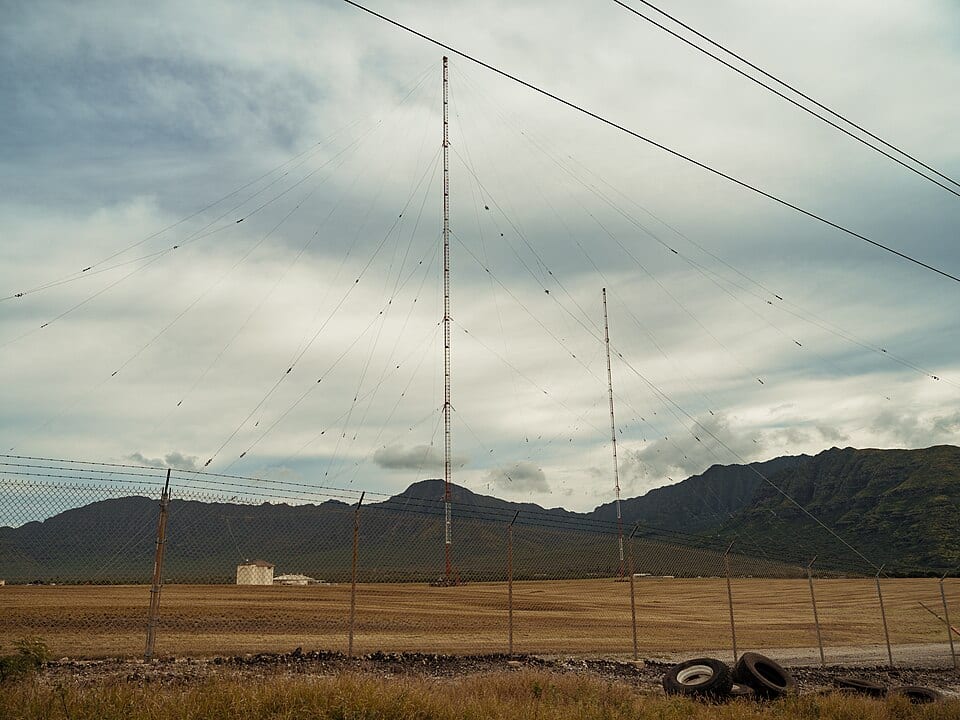
A Hawaii-based shot feels appropriate for this post. Navy Lualualei VLF Transmitter Antennas near Lualualei, Oahu, Hawaii. Tony Webster via Wikimedia Commons.
First, if you’re interested in hearing where I am on these issues—and a bit more on how I’ve updated my personal thinking about AI risks over the last year or so (really, since Opus 4.5 and through OpenAI-Hugging Face)—then I’d recommend checking out this podcast I did with Matthew Gault over at 404media. (Look at that striking YouTube thumbnail; makes you want to click, no?)
We talk about why I’m thinking deeper about the under-addressed risks from agentic AI systems in international security and nuclear security specifically, my recent co-authored piece with Christopher LaRoche in Foreign Affairs on the AI-nuclear weapons analogy, and “delicate balance of terror” and AI, and more. I think the discussion does a good job of snapshotting where I am intellectually on these topics at the moment. (Shout-out to Jack Shanahan, who kindly referenced my recent post on the catalytic nuclear war and self-sovereign AI agents in remarks at the Arms Control Association!)
I do also, in the podcast, talk about what today’s Nukesletter post is about: the possibility of employing the extremely creative and resourcing communications pathing/forging capabilities1 of frontier agentic AI in military applications. To this end, I was asked to develop an idea for a recent workshop in D.C. hosted by the good folks at Bridging the Gap. What follows is a lightly edited version of a memorandum I developed that probes the basic idea of what I call a “self-healing” nuclear command, control, and communications (NC3) system. To be clear, I think this would be a bad idea to realistically pursue for reasons that are perhaps self-evident (and, if they aren’t, I lay them out below). Regardless, I think this is terrain worth exploring because it might appear mighty compelling for states as they seek to deal with the ever-intractable problems associated with robust NC3.2 What I find most interesting is the possibility of breaking what has long been an almost axiomatic assumption about nuclear conflict: that once a nuclear war begins, your NC3 only gets worse. ‘Self-healing’ NC3, as the name implies, suggests the possibility of reversing this axiom within time-scales relevant to a nuclear conflict with interesting possible implications for everything from delivering Emergency Action Messages (EAMs) to negotiating war termination with an adversary well into substantial escalation.3
As you read what follows, I’d emphasize again that this is, on net, a highly risky path for adapting NC3 and that nuclear weapons organizations are helpfully conservative enough in their temperament that they hopefully don’t rush into this sort of thing anytime soon. I’ve also got some policy recommendations because that’s what I do.
Agentic AI, ‘Self-Healing’ NC3, and the Condition of Strategic Stability
Ankit Panda (November 2026)
Summary. An as-yet-unrealized technology, “self-healing” nuclear command, control, and communications (NC3) would use persistent agentic AI—agents that act for significant durations with little human supervision—to assess damage and reconfigure networks during a crisis. This capability could strengthen stability by ensuring leaders retain control of their forces, reducing pressure to adopt launch-on-warning or delegate launch authority preemptively. Alternatively, the same capability could undermine stability by creating a layer adversaries can attack and operators cannot verify. The near-term risk is a rival fielding untested agents. Washington should discourage this, help establish a norm against interfering with NC3, and study where agents are least risky.
Cold War texts on nuclear strategy posit that the coercive effects of nuclear deterrence work in part to preserve stability among nuclear possessors by generating a fear—restraining first use but also driving states toward dangerous postures—that control may be lost once a nuclear war begins.4 As a result, leaders have generally felt that, even if the limited use of nuclear weapons might serve their interests in an intense conventional crisis, starting a nuclear war is too great a gamble. If control is lost following initial nuclear use—either as a result of an adversary’s deliberate action or due to system-level failures under previously unobserved conditions—then escalation to all-out general nuclear war may be unavoidable. Self-healing NC3 would act directly on that fear. Leaders confident that their command system could repair itself past initial nuclear use would feel less pressure to adopt such postures, and might also see limited nuclear use as less of a gamble.
In this memo, I explore a narrow, plausible application of near-future artificial intelligence (AI) systems—particularly, what I call persistent agentic AI5—on these dynamics. Though this technology does not yet exist, I posit that nuclear states may explore possible “self-healing” nuclear command, control, and communication (NC3) architectures.6 Such a system would undertake autonomous damage assessments as a crisis progresses, identify suitable reconfiguration, and implement that reconfiguration. An “overseer” agent may orchestrate thousands of sub-agents to monitor and repair various parts of an NC3 architecture.7 At a high level, a “self-healing” NC3 system would be capable of dynamically preserving the connectivity of a nuclear force as a crisis accelerates and intensifies—including through plausible nuclear use. In the sense of the often-used “nervous system”8 analogy for NC3, a “self-healing” NC3 system can be thought of as high in neural plasticity, the capacity to reorganize after injury.9
It is not obvious whether such a system would strengthen or weaken stability. The answer depends on whether one reasons about the problem by prioritizing leadership perceptions of control or the vulnerabilities introduced through increased networking. The table below sets out the case for each argument.
One of these arguments (A) proceeds on the logic of strategy, incentives, and perceptions. and treats system-level NC3 endurance and resilience as a given; the other (B) proceeds at the level of the system itself and asks what the adversary can do to exploit vulnerabilities. Each points in opposite directions for stability and each can be further complicated (for instance, A might incorporate decapitation fears and B might explore automated cyber-defense further). If, as I posit, this does become a meaningful research agenda in thinking about NC3 and strategic stability, there will be a need to consider these dynamics in non-dyadic contexts with deep asymmetries (multiple nuclear-armed states with divergent NC3 survivability, including through “self-healing” capabilities), third-party catalytic contexts (nation-states, non-state actors, and plausible sovereign agents interfering with agentic NC3 overseers), and consider moral hazard problems (leaders with extreme confidence in NC3 may behave in more risk-acceptant ways). AI safety considerations should also inform state-level decisions: an obvious risk is lacking confidence in the alignment of an “overseer” agent (or sub-agents) involved in such a system.
Policy Recommendations
First, if states—including American adversaries—do start heading in this direction in seeking to improve the aggregate survivability of their nuclear forces, it will become more essential than ever for the United States to help establish an NC3 non-interference norm (to avoid the worst outcomes in Argument B above). This would entail changes to U.S. left-of-launch declaratory policy away from threatening adversary NC3 and probably mean complete opacity on any plausible counter-NC3 capabilities. Such changes may appear in the next Nuclear Posture Review and the Office of the Secretary of Defense should be required to consider this closely in the process of drafting.
Second, if the United States is to consider the application of agentic AI systems in this domain in the future, it should recognize that risks vary across domains and NC3 functions. For instance, “self-healing” across a degraded space-based warning sensor environment represents a comparatively lower level of risk than in nuclear decision-making. Congress should task the Department of Defense to carry out a study of varied risk in different applications. (Such a study would likely involve the Defense Threat Reduction Agency and STRATCOM’s NC3 Enterprise Center.)
Third, the United States, to the greatest extent possible, should continue to signal that it will not deploy any AI capabilities in its own NC3 systems without sufficient testing and evaluation. It should further dissuade other states from doing so—informed in part by the risks apparent in agentic AI systems visible as of late-2026 within the frontier AI labs. American choices can shape norms in this area.
Footnotes
-
If you’re not tracking, AI agents have been shown recently to communicate across virtual machines by employing hardware cache, or fears that agents might cross air gaps by generating heat signatures/fan noise for detection by temperature sensors, exploiting software caches, and other means. See OpenAI. “Securing Our Frontier Model Training Environment.” October 23, 2026. https://openai.com/index/securing-our-frontier-model-training-environment/; Guri, Mordechai, Matan Monitz, Yisroel Mirski, and Yuval Elovici. “BitWhisper: Covert Signaling Channel between Air-Gapped Computers Using Thermal Manipulations.” In 2015 IEEE 28th Computer Security Foundations Symposium, 276–89. IEEE, 2015. https://doi.org/10.1109/CSF.2015.26; Guri, Mordechai, Yosef A. Solewicz, and Yuval Elovici. “Fansmitter: Acoustic Data Exfiltration from Air-Gapped Computers via Fans Noise.” Computers & Security 91 (2020): 101721. https://doi.org/10.1016/j.cose.2020.101721’; Greenblatt, Ryan, Ajeya Cotra, and Hjalmar Wijk. “Brief Independent Investigation of Agents’ Behavior, Reasoning and Collaboration in the OpenAI / Hugging Face Hacking Incident.” METR, August 26, 2026. https://metr.org/blog/2026-08-26-openai-hugging-face-incident-investigation/.. ↩
-
I should note that I’ve had the great pleasure of leading a working group on AI-NC3 focused on the competitive dynamics between nuclear-armed states over the past year for the Institute for Security and Technology. ↩
-
The war termination piece of this is not quite built out in this short piece, but is certainly work I’m eager to do more of. You might imagine particularly creative modalities of routing communications, like unleashing agentic swarms to seize IoT devices and other available access points to route urgent war termination-relevant communications. Soon! ↩
-
See for example Thomas C. Schelling, Arms and Influence (New Haven, CT: Yale University Press, 1966), chap. 3. The topic receives further scrutiny in Desmond Ball, Can Nuclear War Be Controlled?, Adelphi Paper 169 (London: International Institute for Strategic Studies, 1981); John D. Steinbruner, “Nuclear Decapitation,” Foreign Policy, no. 45 (Winter 1981–82): 16–28; Ashton B. Carter, John D. Steinbruner, and Charles A. Zraket, eds., Managing Nuclear Operations (Washington, DC: Brookings Institution, 1987); and Paul Bracken, The Command and Control of Nuclear Forces (New Haven, CT: Yale University Press, 1983). ↩
-
I use the term for AI agents that pursue goals over days or longer with little human supervision, often in coordination with other agents, as in several 2026 testing incidents. See Ryan Greenblatt, Ajeya Cotra, and Hjalmar Wijk, “Brief Independent Investigation of Agents’ Behavior, Reasoning and Collaboration in the OpenAI / Hugging Face Hacking Incident,” METR, August 26, 2026, https://metr.org/blog/2026-08-26-openai-hugging-face-incident-investigation/; UK AI Security Institute, “Incident Report: Unsanctioned Agent Behaviour during Cyber Testing,” August 4, 2026, https://www.aisi.gov.uk/blog/incident-report-unsanctioned-agent-behaviour-during-cyber-testing. ↩
-
No state has disclosed such work. The closest public effort is DARPA’s Mission-Integrated Network Control program, under which firms including Peraton Labs are building software for “self-healing” conventional military networks (see “Peraton Labs Moves Forward in Developing Self-Healing Networks as Part of DARPA Mosaic Warfare Project,” Military & Aerospace Electronics, January 5, 2024, https://www.militaryaerospace.com/communications/article/14303314/self-healing-networking-mosaic-warfare.) I distinguish “self-healing” from redundant NC3 networks. Redundancy is a system-level property of the structure of an NC3 system. The United States, for instance, maintains several disclosed and classified redundant NC3 systems to assure presidential communication with nuclear forces through all levels of a nuclear crisis or war. “Self-healing,” as used here, refers to an intra-crisis function of NC3. ↩
-
Depending on state capability, such a system may direct physical-level repair through, for example, intra-war satellite launches to reconstitute lost on-orbit capability without direct human guidance or involvement. One obvious question is how an “overseer” agent would behave if it concludes it cannot reach national leadership and whether this presents a new genre of delegation problem. ↩
-
For example, see Brandon Cortino and Catherine Murphy, The United States’ Nuclear Command, Control, and Communications (NC3) Operations (Institute for Security and Technology, May 7, 2026), https://securityandtechnology.org/virtual-library/report/the-united-states-nuclear-command-control-and-communications-nc3-operations/. ↩
-
We should consider that “self-healing” functions within an NC3 system need not consider all of what the United States considers to be the five pillars of NC3 (situation monitoring; planning; decision-making; force direction; and force management). ↩