Logics of Arming: 11 Propositions of American Nuclear Strategy
Happy Sunday, Nukesletter readers! This one is a bit longer than usual.
Below are eleven propositions on the role of nuclear weapons for the United States that I think define the most mainstream branch of American nuclear strategy as it has existed since the latter half of the Cold War (with minor variations at the margins).
As you read them, flag which of the below premises you agree with and which you disagree with. For simplicity, these premises don’t get into granular cost matters or allies and extended deterrence.
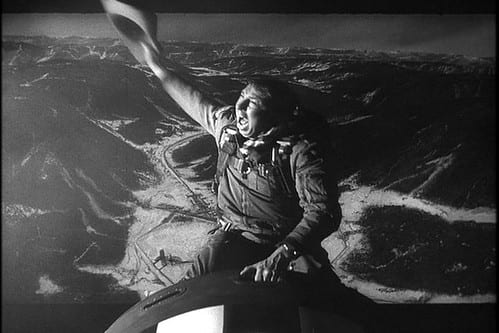
Major T. J. “King” Kong’s final flight in Dr. Strangelove or: How I Learned to Stop Worrying and Love the Bomb (1964). Creative Commons image.
-
Deterrence of both war and escalation within wars (including nuclear wars) is desirable for the United States.
-
Nuclear weapons, through their mere existence and through the possibility of their employment, confer some deterrence1 effects on American nuclear-armed adversaries.
-
The magnitude of these effects are unknowable with precision, but nonzero.
-
These effects can’t be replicated with nonnuclear arms or other instruments of national power.
-
-
If 1 and 2 are true, the benefits of possessing and sustaining nuclear weapons likely outweigh the costs, even if the costs are high in absolute and/or relative terms to the totality of the U.S. defense budget.
-
The deterrence effects of American nuclear weapons in peacetime, crisis, and within war have some relationship to the numbers and types of nuclear weapons.
-
The deterrence effects of American nuclear weapons in preventing wars has some relationship to the numbers and types of nuclear weapons.
-
The deterrence effects of American nuclear weapons in preventing escalation in a crisis and within wars has some relationship to the numbers and types of nuclear weapons.
-
The relationship between the number of nuclear weapons and their deterrence effects is not linear.
-
-
It is unknowable a priori what world states might follow nuclear employment (either by the United States or a nuclear-armed adversary) in a war. The possibilities that follow include:
-
prompt war termination2,
-
deescalation,
-
escalation,
-
catastrophic escalation.
-
-
If 1 and 2 are true, the United States should possess and sustain nuclear weapons as long as other states possess nuclear weapons.
-
If 1, 2, 4(a), 4(b), and 4(c) are true, the numbers and types of nuclear weapons will be a question of strategic importance for the United States as long as nuclear weapons exist.
-
If 5 is true, the best outcomes of any nuclear employment within a war by the United States are 5(a) and 5(b). By extension, 5(c) is a bad outcome. 5(d) is a catastrophic outcome. As such, 5(c) and 5(d) deserve special consideration in American strategy.
-
It is unknowable whether escalation within a nuclear war can be effectively managed, but, given nuclear wars are possible, the United States should seek to sustain capabilities to manage escalation favorably (in effect, seeking to the greatest extent possible to avoid the world states encompassed by 5(c) and 5(d)).
-
If 9, the probability of managing escalation favorably within a nuclear war increases with the types of nuclear weapons.
-
Given the unknowability of world states that might follow nuclear employment, a greater number of types of nuclear systems confers flexibility. This is desirable.
-
A variety of means of delivery and weapons yields allows for a diverse choice of weapons effects and domain-specific retaliation (including regionally).
-
-
If 9, the probability of managing escalation favorably within a nuclear war increases with the numbers of nuclear weapons.
-
The size of the U.S. nuclear arsenal is positively correlated to its aggregate survivability. This contributes to escalation management by assuring unacceptable damage against an adversary should they resort to large-scale strikes.
-
The size of the U.S. nuclear arsenal contributes to the credibility of damage limitation options. This contributes to escalation management by conveying American escalation dominance at the highest levels of violence imaginable within a nuclear war.
-
The credibility of damage limitation options is a function of adversary force size.
-
Adversaries seek to contest the credibility of American damage limitation options to preserve force survivability.
-
-
If you made it this far, it’s overwhelmingly likely that you disagreed with at least one of the above propositions (though I can think of at least a few people who would nod along to all of them3—you know who you are!).
I’ve been working on these propositions for a bit informally in the context of some of my nuclear strategy work relating to the problem of escalation management within a nuclear war. It felt right to publish this now given the growing interest in the Trump administration’s upcoming nuclear strategy review, which, according to press reports last month, will be navigating questions of weapons numbers and weapons types.
I find that thinking through these propositions is a useful sorting mechanism for where one stands on questions of nuclear strategy in the United States. For instance, many in the disarmament advocacy community probably bowed out of the exercise at 2 or 3. Minimum deterrence proponents and restrainers might have bowed out at 4, and probably additionally don’t love 2(a) and 2(b). Both hawks and doves might point to the orders-of-magnitude difference in bad-ness between 5(c) and 5(d), which are treated as an equivalent class of negative outcomes to solve for above.
If you make it past 4, you’re probably nodding along with most of the rest—until 10 and 11, which what I see as the crux of contemporary controversy in debates about American nuclear strategy.4 These questions have gained greater salience recently because of the growing perceived risk of a conventional conflict with a nuclear-armed great power adversary (which may then lead to a nuclear war) and the end of the New START treaty in February 2026. We’re all talking about numbers and types again!5
Close readers may start to pick up on some important sources of tension between 9, 10, and 11. For instance, the case for a diversity of types of nuclear weapons is, on net, stronger than a case for more nuclear weapons with the propositions as written. 10’s flexibility rationale, for instance, is totally insensitive to adversary force size while 11(b) has the United States pacing credible damage limitation as a function of adversary force size. 10 also appears to follow most consistently with 9: if the goal is avoiding 5(c) and 5(d), the capabilities that matter most are those permitting options calibrated low enough to terminate rather than provoke. But given 5 and 9, 11(b) becomes relevant again. 9 and 11(b) also raise the classical “use-it-or-lose-it” crisis instability case against damage limitation—so one might see a contradiction in terms between seeking to minimize world state 5(d) and 11(b).6
We also have an important internal loop within 11: 11(b)(i) and 11(b)(ii) suggest no internally definable force-sizing logic: Adversaries contest American damage-limitation credibility by adding survivable forces, raising the number required to sustain credibility, giving further reason to add. 11 overall comes into tension with 4(c) when one begins to think about what deters generally in peacetime and what might deter within a nuclear conflict.7 The propositions, notably, do not offer clarity on which of these problems the nation should optimize for and why. By extension, the greatest unconstrained upward growth pressure on force size originates in 11(b); it’s the only proposition that has no internal stopping rule (because of the sensitivity to adversary choices).
Two really important takeaways—the ones most important to my thinking—are on the role of judgment and uncertainty. You might have noticed that many of the propositions are framed probabilistically or assert that some things are just unknowable; perhaps you disagree with these propositions. I lack your confidence. A consequence of this is that my thinking strongly leads me to conclude that force posture and sizing decisions are judgment problems requiring thoughtful, prudent civilian leadership in the United States (a theme of the final chapter of my recent book). Military planners and nuclear strategists left to open-ended optimization for the above-stated propositions will be strongly led to move the curve on what the United States can ask of its nuclear weapons by seeking an exceptionally capacious expansion of capability.
The propositions do not license either minimalism or maximalism for American nuclear strategy and force posture, I think. They also leave open an important function for arms control. Of course, I’m not naive about the prospects for arms control in the current environment, but for judgment and prudence to prevail over these difficult questions, we should remember that a core function of arms control is to, above all, provide predictability and transparency (i.e., collapse some of the epistemic uncertainty) in ways that make it more possible to get the answers right on force planning.
There are some things that are more knowable that aren’t dealt with in the above set of propositions. For instance, American industrial fitness for competition is one such matter. 11(b)(ii)’s tension with 11(b) leads to an equilibrium where adversaries offset any increase in U.S. damage limitation capabilities (as a spiral or arms-racing model would predict). Alternatively, if the United States can be hyper-fit to compete and asymmetrically outpace the defense industrial and nuclear enterprise capacities of its adversaries, this tension may be more reducible. Of course, this is not actually knowable today, but these are things that are relatively prone to measurement and observation over time (and may be meaningfully affected by advances in frontier artificial intelligence, etc.).
The core role for civilian—ideally, presidential8—judgment over these questions is in ruling out and ruling in certain types of risk the United States must accept in our new nuclear age. It’s not controversial that risk cannot be reducible to zero, but I do hold that the United States is entering a period where the aggregate risk we will tolerate in our nuclear strategy will be greater across peacetime, crisis, and wartime alike. I will aim to build this argument out in longer form elsewhere.
Footnotes
-
Deterrence is a form of coercion, so if you’re thinking about coercion here, it’s fair. ↩
-
Under U.S. war aims; not suggested U.S. capitulation, which is technically war termination also. ↩
-
I tend to think if you agree with all of these propositions, you will be rather happy working on nuclear strategy matters within the U.S. government in some capacity. ↩
-
You can see manifestations of this debate most recently in Erin Dumbacher’s recent Foreign Affairs article arguing rather strongly against the idea that more nuclear weapons confer benefits, and Austin Long’s response over at Strategic Simplicity. ↩
-
The NC3 nerd in me feels the need to flag here that the idea of deliberate, discriminate, sequenced employment after nuclear use has begun requires survivable command and control, attack characterization, damage assessment, and probably a functioning channel to the adversary. None of this is discussed here, but these are very important things indeed. ↩
-
My colleague James Acton makes the representative argument for this. See here. ↩
-
If you treat damage limitation requirements as monotonically increasing with sharply diminishing returns, then you do get nonlinearity in requirements. ↩
-
Unlikely to be found anytime soon. ↩